Post-2026 Draft EIS Alternatives
No Action Alternative
The No Action Alternative is included as a requirement of NEPA. Operations would revert to annual determinations announced through the Annual Operating Plan. Pursuant to the LROC, the objective is to maintain a minimum release of water from Lake Powell of 8.23 maf, therefore Lake Powell releases are assumed to be 8.23 maf¹ unless a higher release is required for equalization or a lower release occurs due to Glen Canyon Dam infrastructure limitations.² Shortages to the Lower Basin would be based on priority and reach a maximum of 600 thousand acre-feet (kaf). This would not represent a continuation of current operations but is generally based on the operating guidance that was in place before the adoption of the 2007 Interim Guidelines. While the authority to use CRSP Upper Initial Units to respond to exigent and emergency conditions was recognized at that time, no specific framework for such activities had been developed, so no defined activities are included in this alternative. Existing Intentionally Created Surplus (ICS) would be delivered in accordance with existing agreements, but there would be no new storage and delivery mechanisms.
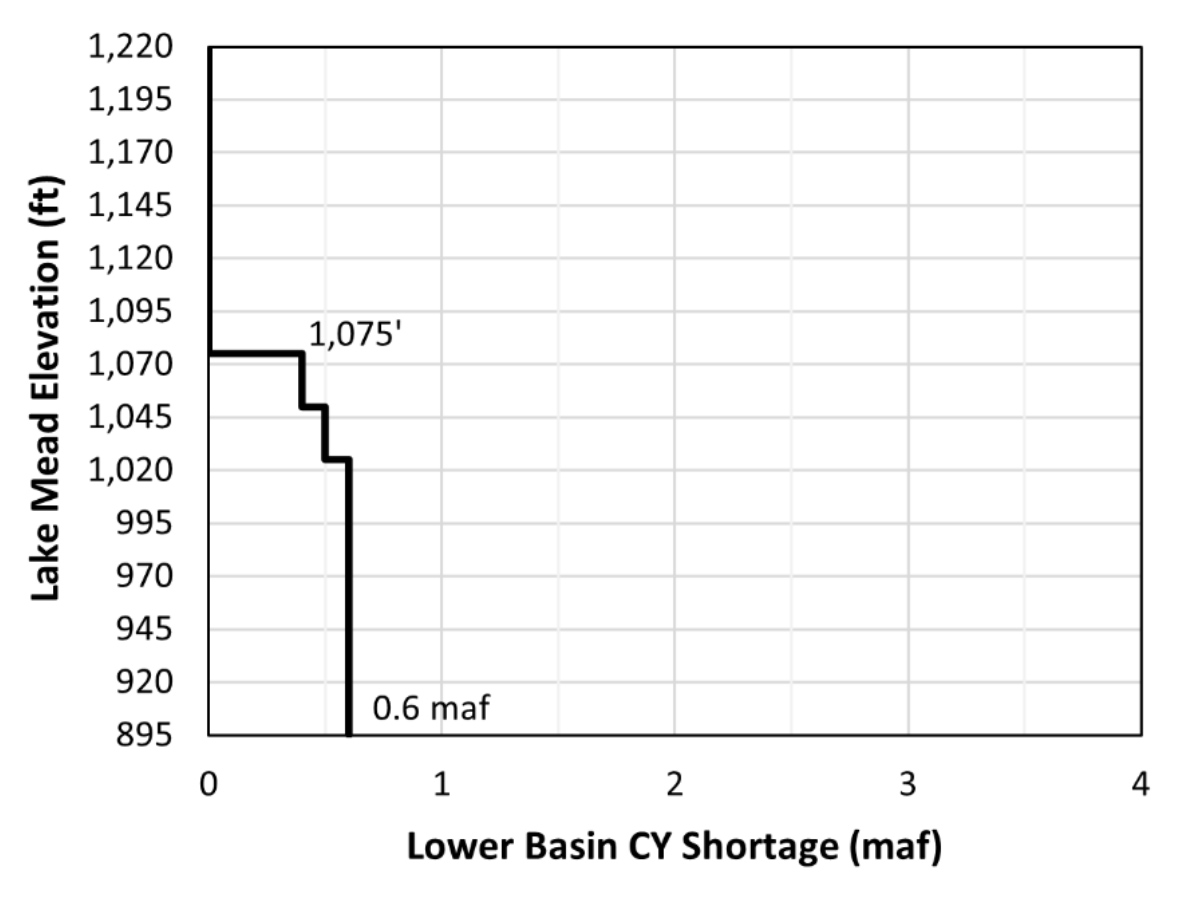
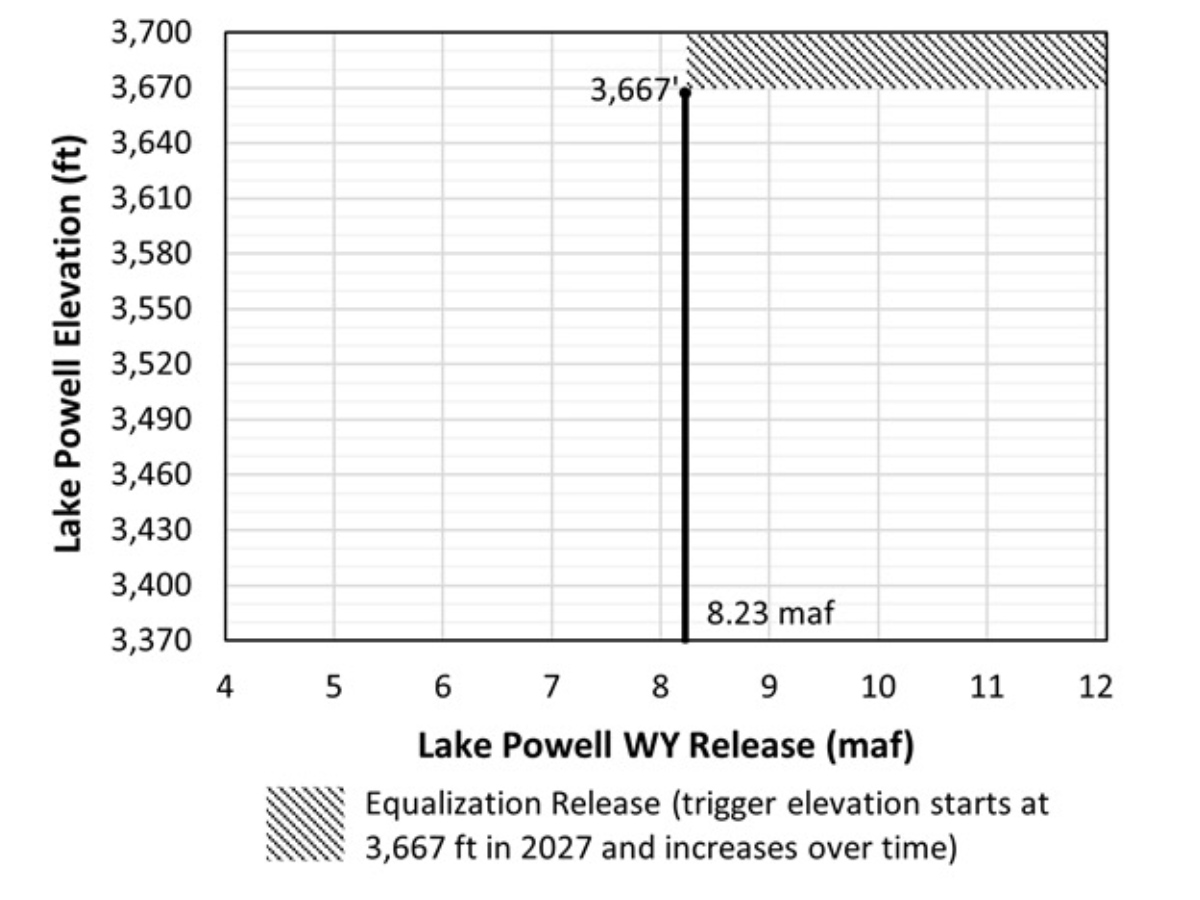
Shortage Guidelines to Reduce Deliveries from Lake Mead³
- Shortages determined based on Lake Mead elevation
- Shortage volume of 400, 500, and 600 kaf at elevations 1,075, 1,050, and 1,025 feet, respectively
- Shortages distributed based on priority
Coordinated Reservoir Operations (Lake Powell and Lake Mead)
- Lake Powell release of 8.23 maf unless more is required for equalization releases
- Releases less than 8.23 maf below elevation 3,490 feet due to Glen Canyon Dam infrastructure limitations
Storage and Delivery of Conserved System and Non-system Water (Lake Mead and/or Lake Powell)³
- No new storage and delivery mechanism to replace ICS
- Delivery of existing ICS in accordance with existing agreements
Surplus Guidelines to Increase Deliveries/Releases from Lake Mead³
- Surplus determinations limited to 70R (spill avoidance strategy) and Flood Control conditions
Additional Activities Above Lake Powell
- No specific additional activities above Lake Powell defined
¹ Article II(2) of the LROC states the “objective shall be to maintain a minimum release of water from Lake Powell of 8.23 [maf].” Reclamation recognizes that entities in the Basin have different legal positions regarding how this LROC statement incorporates other Law of the River elements to determine annual releases. Reclamation also recognizes that variation in releases of water above and below the minimum objective release of 8.23 maf can, in appropriate circumstances, be adopted.
² Releases from Glen Canyon Dam may be unable to achieve the specified annual release volume when Lake Powell is below elevation 3,490 feet due to infrastructure constraints. Modeling assumptions for all alternatives reflect this constraint (see Appendix A).
³ These operational elements contain modeling assumptions for water deliveries to Mexico. Shortage volumes include assumptions related to reductions in water deliveries to Mexico. Lake Mead storage volumes for the Storage and Delivery of Conserved System and Non-system Water include assumptions related to storage available to Mexico. Surplus Guidelines include assumptions related to increased deliveries to Mexico. Appendix A provides additional detail. Reclamation's modeling assumptions are not intended to constitute an interpretation or application of the 1944 Water Treaty or to represent current United States policy or a determination of future United States policy regarding deliveries to Mexico. The United States will conduct all necessary and appropriate discussions regarding the proposed federal action and implementation of the 1944 Water Treaty with Mexico through the IBWC in consultation with the Department of State.