Post-2026 Draft EIS Alternatives
Maximum Operational Flexibility Alternative
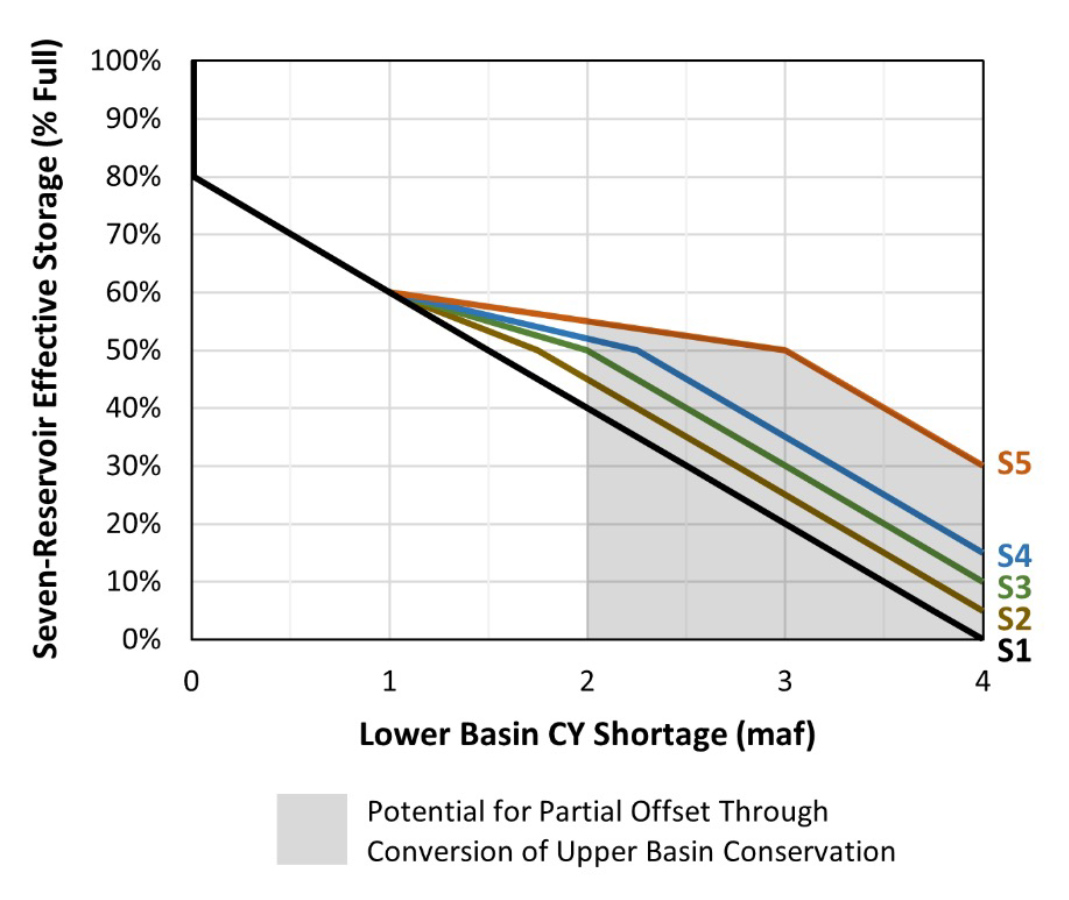
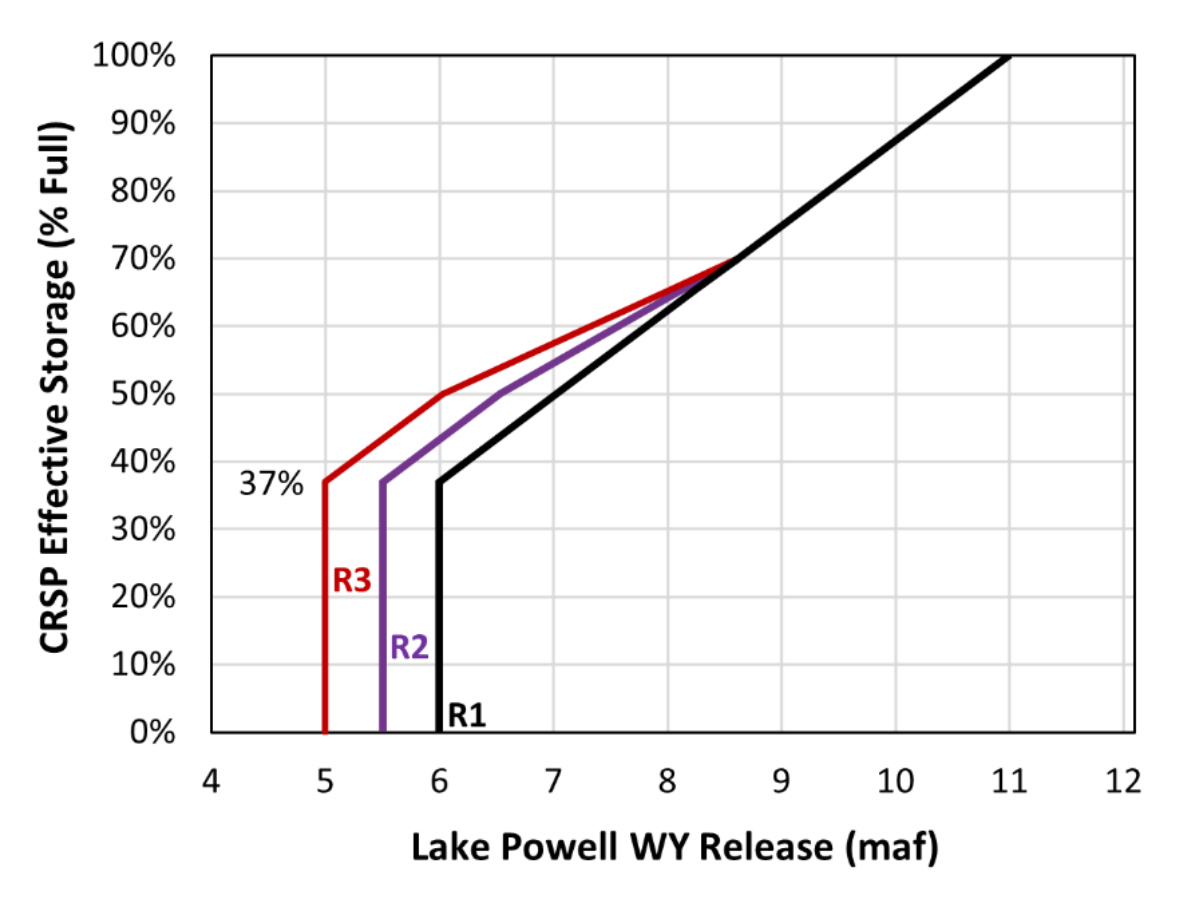
This alternative is informed by a proposal submitted by a consortium of conservation organizations and incorporates proactive responses, targeted reservoir management strategies, and innovative and flexible tools to address an increasingly variable set of future hydrologic conditions. Lake Powell releases would range from 11.0 maf to 5.0 maf and would be determined by total CRSP system storage and recent hydrology. Releases would switch to “run-of-river” when Lake Powell is at 3,510 feet or lower. The operations incorporate Basin-wide shared contributions, including up to 4.0 maf of shortages in the Lower Basin triggered by combined seven-reservoir storage (CRSP Units, Lake Mead, Lake Mohave, and Lake Havasu) and recent hydrology and voluntary water contributions from both basins.
Shortage Guidelines to Reduce Deliveries from Lake Mead³
- Shortages determined based on combined seven-reservoir storage and recent hydrology
- Shortages start at 80% full and increase linearly, subject to upward adjustment based on hydrology, reaching a maximum of 4.0 maf
- Shortages distributed based on priority, as described in Approach 1 of the Supply Driven Alternative
Coordinated Reservoir Operations (Lake Powell and Lake Mead)
- Lake Powell releases determined based on total Upper Basin system storage and recent hydrology
- Releases subject to downward adjustment based on hydrology and range from 11.0 to 5.0 maf
- Releases switch to “run-of-river” when Lake Powell is at elevation 3,510 feet or lower
Storage and Delivery of Conserved System and Non-system Water (Lake Mead and/or Lake Powell)³
- Storage up to 8.0 maf in either Lake Powell or Lake Mead; excluded for purposes of determining Lake Powell releases and shortages
- Existing ICS converted to new mechanism over 5 years
- Extensive flexibilities for all users: transactions within and across basins, including interstate and inter-basin
Surplus Guidelines to Increase Deliveries/Releases from Lake Mead³
- Surplus determinations limited to Flood Control conditions
Additional Activities Above Lake Powell
- Average of 200 kaf of Upper Basin annual conservation based on hydrologic conditions contributed to the Lake Powell conservation pool
³ These operational elements contain modeling assumptions for water deliveries to Mexico. Shortage volumes include assumptions related to reductions in water deliveries to Mexico. Lake Mead storage volumes for the Storage and Delivery of Conserved System and Non-system Water include assumptions related to storage available to Mexico. Surplus Guidelines include assumptions related to increased deliveries to Mexico. Appendix A provides additional detail. Reclamation's modeling assumptions are not intended to constitute an interpretation or application of the 1944 Water Treaty or to represent current United States policy or a determination of future United States policy regarding deliveries to Mexico. The United States will conduct all necessary and appropriate discussions regarding the proposed federal action and implementation of the 1944 Water Treaty with Mexico through the IBWC in consultation with the Department of State.